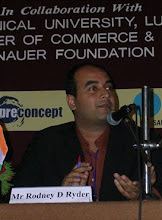
On a trip to Helsinki in Finland, Rajjat Barjatya stumbled upon 15,000 Indian families who had regular access to Bollywood movies even when no production house was distributing them there.
"The families were paying monthly rent to a website that delivered the latest pirated Bollywood content," says Barjatya, who figured that the Indian entertainment sector was being plagiarised and producers who were spending millions on marketing and publicity were being robbed, virtually.
"There was a huge gap in demand and supply of Bollywood content to NRIs settled all over the globe," adds Barjatya, the managing director of Rajshri Media, the digital arm of Rajshri Productions.
Today, Barjatya is doing a roaring business among the NRI population settled in the US, UK and Canada. Success speaks for Barjatya. Rajshri's blockbuster film Hum Aapke Hain Kaun has been viewed over 500,000 times till date and can be downloaded for $4.99.
The website hosts over 6,000 hours of premium video content, all of which has been licensed from India's leading content owners and can be streamed free, ad-supported and downloaded at a nominal price between $4.99 and $9.99.
Barjatya has also unveiled 90 webisodes and mobisodes, of three minutes each, that will be available for free online streaming and as mobile downloads for Idea subscribers.
Piracy of intellectual property is not new to the media and entertainment sector. However, the scale of the problem is definitely new-fangled. A recent study estimates that the Indian entertainment industry loses $4 billion and more than 800,000 jobs each year because of piracy.
Not ready to give up on digital distribution just yet, entertainment majors such as Rajshri Media, UTV, YashRaj Studios, and Shemaroo Entertainment, among many others, are slowly building their digital roadmaps to tap the 5 million broadband-connected homes in India.
Not ready to give up on digital distribution just yet, entertainment majors such as Rajshri Media, UTV, YashRaj Studios, and Shemaroo Entertainment, among many others, are slowly building their digital roadmaps to tap the 5 million broadband-connected homes in India.
"First with music, and now with movies, as broadband capabilities expand, hundreds of thousands of copies race across the Internet daily, clearly harming producers and legitimate retailers," laments Siddharth Roy Kapur, CEO, UTV Motion Pictures.
In the US, the largest market for both Bollywood and non-Bollywood content, there are about 200,000 Indian millionaires, with some 15 per cent of Silicon Valley start-ups believed to be owned by Indians, according to a report by JPMorgan. UTV, informs Kapur, will look to target the overseas customers first with its digital offering.
Filmed entertainment executives have only to look at the music industry to see the dangers of insufficient action — take digital piracy seriously or lose billions as well as fundamental control of the value chain.
Barjatya probably read the warning signals in 2006. He released Rajshri's film Vivah online back in 2006 expanding his distribution for the 25 million Indians spread across the globe. "Physically reaching so many people is not possible and yet these are affluent NRI households with an appetite for Indian cinema. So, the Internet is the best medium to supply cinema as close to 51 per cent of NRI households have broadband access," mentions Barjatya.
Thanks to broadband penetration, digital theft has become free or costs as much as a writeable CD. Kapur acknowledges and says, "The rising number of user-generated sites like YouTube has made it easier to share videos. We do send notices to websites hosting illegal content and they respond favourably by taking off the content."
But the rising number of video-hosting sites also means that it is virtually impossible to keep track of illegal videos. Even as India's box office revenues are expected to swell up to $7.4 billion by 2010, according to PricewaterhouseCooper estimates, the downloaded content can garner more than $1.4 billion for the producers.
UTV is already rethinking its pricing strategy and release schedules for its online consumer by tightening digital distribution and security to control data leaks.
"We are working with technology companies to develop workable online distribution and rights management systems and to create easy-to-use channels at the right price," he says.
Technology can be a big help for the industry. Rising acceptance of peer-to-peer (P2P) networks among youth allows them access to one anothers' hard drives, enabling files to be freely copied or distributed from one computer to another. P2P networks do not use a central server and hence are difficult to track down, disable or prosecute.
For instance, when The Matrix Reloaded was released, pirates used a file-sharing computer programme called BitTorrent that let digital thieves download films for free within three hours of its release.
Rana Gupta, business head, Safenet, explains, "The impact of such incidents on a film's ultimate box-office and DVD performance is hard to gauge, but the longer you can prevent a scenario like this the better the return on investment for a studio."
Earlier this year, Ratatouille, the animated film from Walt Disney's Pixar, made its way online about 10 days before its release. Safenet's MediaSentry services help the studios in infringement management, early leak identification services, and various business intelligence tools to analyse data online.
"MediaSentry enables content producers to track down websites infringing copyrighted data," Gupta says. Simply put, Safenet's proprietary technology gets the digital addresses of those who download illegal files and this information is given to the Internet service providers (ISPs), which can ask the customer to stop.
Legal action has closed some sites that connect users with pirated movies. Motion Picture Association of America won its battle with TorrentSpy, a peer-to-peer site that is now closed. But Pirate Bay, a similar Sweden-based service, is still running. Pirate Bay creators say it is merely a platform and is neither uploading nor downloading proprietary content.
Back in India, Rajshri Media uses digital media rights (DRM) protection to prevent illegitimate duplication of its content, it isn't exactly foolproof. "We are focusing on bridging the demand gap and haven't really invested in protecting content from bootleggers. But we are evaluating various software techniques to make the Internet a more secure medium of distribution," adds Barjatya. It looks like a long way before Barjatya and Kapur can cast a virtual safety net over their digital assets. No one expects to eliminate piracy. But given that a film's opening weekend often accounts for 60 to 70 per cent of its earnings, every day's delay in the availability of pirated copies can make a big financial difference.