Showing posts with label domain names. Show all posts

Tuesday, September 22, 2009

Ta Ta, WIPO. New Candidate for Worst UDRP Decision Ever [WIPO]

An Indian company is taking a domain battle to court after a WIPO domain panelist handed its domain owner to conglomerate Tata Sons. The domain at issue is OKTaTaByeBye.com, a travel web site based on the colloquial saying “Ta Ta”, as in bye-bye or see you later. OKTaTaByeBye.com is run by a large online travel company that operates MakeMyTrip.com.

TaTa Sons stated in its complaint that “the Respondent has not shown any demonstrable preparation to use the domain name in connection with a bona fide offering of goods and services.”

OKTaTaByeBye refuted that in its response, stating that the site is a travel journal and community site. A look at historical DomainTools thumbnails shows that the site has been operating since at least 2006 with active traveler discussion boards.

But the response by WIPO panelist Pavan Duggal is almost humorous in nature. Despite the overwhelming evidence presented by OKTaTaByeBye.com that it is a legitimate, online travel community, Duggal focuses on on how the site links back to the company’s MakeMyTrip.com site, where people can book trips online. This, according to Duggal, shows that OKTaTaByeBye.com is actually trying to use TaTa’s trademark to “fish” for new customers to its MakeMyTrip.com site. Apparently operating an online travel community that supports a related web site is not OK.

The company is discussing the fight on its blog in a post that has received 1,256 comments.
Courtesy: Domain Name Wire

Thursday, September 03, 2009

Indian MDH loses to Pakistani MDH in website dispute case [WIPO]

Leading masala-maker Mahashian Di Hatti Ltd, popularly known by its brand name MDH, has lost a website address dispute case against a Pakistani firm engaged in a similar business at the World Intellectual Property Organisation.Mahashian Di Hatti had approached the Geneva-based WIPO Arbitration and Mediation Center objecting the ownership of an Internet site 'mdhfoods.com' by Pakistan's MDH Food Company.
The Indian firm contended before the Center that disputed domain name is identical and confusingly similar to its MDH mark, since it incorporates the mark in its entirety and the addition of "foods" does not detract from its distinctiveness.

Friday, August 28, 2009

Tata Sons wins case against travel portal

Tata Sons, the holding company of the Tata Group firms, has won a case at the World Intellectual Property Organisation against the travel portal, MakeMyTrip, which has been using the term 'tata' in one of its website, 'oktatabyebye.com'. Gurgaon-based mmt admin (commonly known as MakeMyTrip) has been using the domain name 'oktatabyebye.com'.
Tata Sons has contended that it is confusingly similar to its 'Tata' brand and the travel portal runner has no rights or legitimate interests to use it. In May, Tata Sons had moved the Geneva-based WIPO Arbitration and Mediation Center demanding transfer of disputed domain name. The company had argued that the site infringed the right of its registered trademark/service mark 'Tata'. The WIPO has now ordered the transfer of domain name to Tata Sons. "The impugned website incorporates the Tata's orporate name and registered trademark in full and it proves that it is identical in part and confusingly similar to its well-known brand in which the company has a statutory right," Tata Sons had said in its complaint. Replying to the charges, MakeMyTrip had said the usage of the word 'tata' as a gesture finds its mention in the origin of a place called Ta Ta Creek as far back as in the year 1860 and denied that the domain in question is confusingly similar to the trade mark 'Tata' of the complainant. The Gurgaon-based firm stated that "the impugned domain name is derived from the common parlance 'OK Ta Ta Bye Bye' since it signifies travel, journey and related activities. But in its argument at the WIPO, Tata Sons said, 'it is apparent that the sole purpose of registering the disputed domain name is to misappropriate the reputation associated with the complainant's well-known and famous trademark Tata.'
The Internet site owner has registered a separate domain name (makemytrip.com). According to Tata Sons, both the sites offer similar services. However, MakeMyTrip says both cater to separate class of persons. While makemytrip.com offers discounts and easy access to travel plans, oktatabyebye.com lets these travelers make an online records about their journey. The WIPO is a specialised agency of the United Nations for developing a balanced and accessible international system in the field of intellectual property rights. As per details available with the WIPO, Tata Sons during the case had made an effort to settle the issue with the MakeMyTrip, which refused to accept the just demands on the grounds on 'vague reasons.'
This story was sent to us by Shri Siddharth Kumar, Press Trust of India.

Thursday, August 27, 2009

Expansion of Top-Level Domain Names opposed by INTA

The International Trademark Association (INTA) announced in its August 1, 2009 Bulletin that INTA passed a resolution to oppose the current proposal by the Internet Corporation for Assigned Domain Names and Numbers (ICANN) for an unlimited expansion of new generic Top-Level Domain Names (gTLDs).

ICANN sets and manages global policies for Internet gTLDs and has proposed expanding from the 21 existing gTLDs, e.g., .com, .org, and .net, to an unlimited number of gTLDs. A number of organizations in addition to INTA have expressed opposition to ICANN’s proposed expansion of gTLDs. Some view the new policy as a money grab. Others focus on the concerns regarding increased potential for trademark infringement and dilution and complaints that ICANN’s existing system has not been effective at protecting trademarks against cybersquatters already trading among the current gTLDs.
According to the INTA Bulletin, INTA will be issuing a revised Draft Applicant Guidebook for new gTLDs in September 2009. Text of INTA’s resolution opposing the proposed unlimited expansion of gTLDs can be found at www.inta.org.
Expansion of new gTLDs has been a hot topic among domain name and trademark professionals, including business and legal professionals and cyber entrepreneurs. If this topic interests you, consider attending Cyber Symposium 2009 in Lehi, Utah on September 25, 2009. Cyber Symposium 2009 is a full day seminar for business and legal professionals interested in strengthening their presence in the high tech industry. David Kelly, partner and chair of the trademark and copyright practice group at Finnegan, Henderson, Farabow, Garrett & Dunner, LLP, will be lecturing at the Cyber Symposium on the new gTLDs and on monetizing domain names. For more info see: www.utahcyberlaw.org.

Thursday, March 19, 2009

ITC evicts squatter from Indian Domain Name

ITC Ltd has won the case against a cybersquatter who had registered the domain name of its flagship brand Wills. Under the provisions of the .IN Domain Name Dispute Resolution Policy (INDRP), ITC alleged and proved that the domain name registered by UK-based cybersquatter Mark Segal of Namegiant.com, was identical to its trademark and misleading as to its origin.

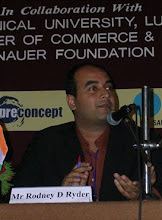
Says Rodney D Ryder, Partner and Head of the Technology Practice at Law Firm Kochhar & Co, which represented the Kolkata-headquartered company, “The domain name is the virtual address of a company, a web mark so to speak. Allowing this domain name registration would be harmful to the ITC/Wills brand as this could also have serious consequences for the company under the Amended Information Technology Act of 2000.” Under the provisions of this act, if a corporate body does not take reasonable security measures to safeguard its data, it could be held liable for any lapse in its data security. The company will be liable to pay compensation up to Rs 5 crore to the parties who has been caused wrongful loss due to deficiency in the security measures adopted by the company.

Registrations under the .in domain have been open since February 2005. Till now, 5 lakh Indian top level domain name extensions have been registered. It is expected in 2 years to cross to 10 lakh registrations. There have been 79 domain name disputes been resolved so far by through The National Internet Exchange of India (NIXI) under the INDRP. Under the Trademarks Act and the Indian Arbitration & Conciliation Act of 1996 cybersquatting disputes are required to be resolved within 45 days up to two months.

Cybersquatting does not only lead to the dilution and/or tarnishment of the brand; if brand owners continue to ignore these sites, such acquiesce could act as a limitation to infringement/cybersquatting actions in the future. Also, this could morph into a phishing or vishing scam or some other dangerous instance of cyber fraud. The domain names should rightfully belong to the brand owner.

In addition, with the enactment of the Information Technology Amendment Act, 2008, the organisation under various provisions has the responsibility to ensure that ‘...reasonable security measures’ are put in place. The organisation could be liable in the event that it ‘acquiesces’ or ‘allows’ its intellectual property or corporate identity to be misused.

Tuesday, March 17, 2009

Cybersquatting up by 8 per cent in 2008: WIPO

Cybersquatting -- holding web domain names hostage for profit -- rose to record levels in 2008, the UN agency for intellectual property rights said.

According to the World Intellectual Property Organisation (WIPO), a record of 2,329 complaints of cybersquatting an 8 per cent increase over 2007 were filed last year, mostly by trademark holders whose names were reserved on the web by other parties.

The increasing number of cases filed with its Arbitration and Mediation Center is occurring at a time when many more domain slots are about to be launched by the Internet Corporation for Assigned Names and Numbers (ICANN), it said adding it expects an in crease in number of such cases.

Thursday, October 30, 2008

ICANN to allow new top-level domains – warning to brand owners

The Internet Corporation for Assigned Names and Numbers (ICANN) is responsible for the allocation of all top-level domain names. There are presently only a limited number of top-level domains (e.g. .com, .net, .org etc) but ICANN has announced it intends to open the market for any person to create new top-level domains of their choosing.
ICANN has issued a draft "Applicant Guidebook" on which it is inviting comments. The draft guidebook may be seen here. ICANN is inviting comments from the public on the draft guidebook, and states that it will receive comments for 45 days (from 24 October 2008). The draft guidebook states that, during the (as yet undetermined) application period, any "established entity" from any country may apply to operate a top-level domain. The top-level domain proposed may either be an "open" domain, which is available to any type of applicant, or a "community based" domain, which must relate to an identifiable and pre-established community that has endorsed the registration of the domain. The application must show that the applicant will have a dedicated registration and use policy, and that the applicant has the operational, technical, financial and organisational capability to maintain the top-level domain proposed. The draft guidebook states that the proposed registration fee for the new top-level domain will be $185,000. Of particular interest to brand owners, the draft guidebook contains details of the proposed objection mechanism which will allow interested parties to challenge the registration of a new top-level domain. The proposed grounds of objection are:String Confusion Objection – existing operators of top-level domains can complain that a domain applied for is confusingly similar to an existing top-level domain; Legal Rights Objection – a "rightsholder" (which is not defined, but this is likely to mean a trade mark owner or someone with unregistered trade mark rights/reputation) may complain that a domain applied for infringes their rights; Morality and Public Order Objection – the parties who may complain about a domain applied for which is contrary to morality and public order are yet to be determined by ICANN, but they may be limited to Government bodies; and Community Objection – an "established institution" within a defined community may complain about a domain applied for which may be targeted at such community if a significant part of that community substantially objects to the application. The draft guidebook contains a long description of the proposed procedure to be followed if objections are raised to top-level domain applications. The procedure will involve arbitration with set rules similar to a UDRP arbitration that is operated by one of a number of providers (e.g. WIPO). The cost of the procedure is not outlined in the draft guidebook, but it is proposed that String Confusion and Legal Rights Objections should be dealt with by the arbitration provider for payment of a fixed fee, and other Objections should be dealt with for payment of an hourly rate. There is no procedure proposed to notify brand owners if a top-level domain is applied for which features a registered trade mark. As a result, brand owners will need proactively to monitor ICANN's website to see the applications that have been made. There is only a limited time period proposed in the guidebook during which objections may be made to applications. It is therefore very important that brand owners wishing to object to applications do so within the required time period. Otherwise, costly court action might be the only remedy available to brand owners after the new top-level domain is approved. Further information about the proposals may be seen on ICANN's website.

Friday, July 25, 2008

Author's estate wins battle of Narnia domain name [UK]

A couple who bought a web domain name as a birthday present for their 11-year-old son have lost a battle with the estate of C.S. Lewis to keep it. Richard and Gillian Saville-Smith, from Edinburgh, paid £70 for the name www.narnia.mobi in September 2006 so that their son Comrie, who is a fan of C.S. Lewis, could use it as an e-mail address. The author's estate lodged a complaint with the World Intellectual Property Organisation, which ruled yesterday that the domain name should be transferred.


Companies had a three-month period in 2006 to express interest in .mobi website names before they became more widely available. The couple bought the Narnia name, along with a number of others, including The Queen.mobi and USPresident.mobi, “just for fun”.

Domain name disputes focus partly on whether a “cybersquatter” is using the site for commercial gain and whether trademarks are involved. Mr Saville-Smith claimed yesterday that he had done nothing at all with the site and had not tried to make any money from it.

Monday, July 21, 2008

Cybersquatting: Don’t let your IP slip through the net

Cybersquatting is the practice of registering domain names incorporating trade marks of third party companies and then trying to sell the domain name back (for a handsome profit) to the trade mark proprietor. It's not going away - it's growing and it's a huge problem for trade mark proprietors.

The number of domain name disputes lodged in terms of the Uniform Domain Name Dispute Resolution Procedure (UDRP) that applies to .com, .net and .org domain names increased by 18% in 2007 compared to the number filed in 2006 and by 48% versus the number lodged in 2005.
The increase can be attributed to:
The rise of "pay-per-click" advertising, whereby cybersquatters associate the domain name they have registered with a website containing adverts promoting a variety of competing brands. Every time Internet users access this website and click on one of the adverts, the cybersquatter receives money.
Domain tasting, whereby cybersquatters register a number of domain names and then wait several days before paying for the domain names. They then count the domain names that attract the most Internet users and then pay for only for those. The remaining domain names are then deleted. Problem is, in the period between the cybersquatter registering and paying (or does not pay) for the domain name, it is reflected as being registered.
The use of privacy services by cybersquatters, who are thereby able to register domain names without revealing their identity to the general public. Cybersquatters can thus remain anonymous while trade mark proprietors must go to great lengths to establish the cybersquatter's identity.
There are a number of steps that companies can take to combat cybersquatting, the most important of which is to develop a domain name registration and conflict policy.
Such a policy would clearly identify relevant criteria to determine which domain names should be registered, whose responsibility it is to administer them and in which countries they should be registered.
As a general rule, companies should ensure that companies register their trade marks and trading names in the countries in which they trade, thereby preventing third parties from launching a website to sell competing goods and services under a domain name identical to a company's trade marks and trading names.
Not only should a company continually ensure that its most important trade marks and trading names are registered as domain names, but it should continually monitor what domain names have been registered that incorporate its trade marks and trading names.
In short, companies must monitor the domain name space to check what domain names have been registered that might incorporate their trade marks and domain names.

Internet domains to open up, prepare for .whatever [International]

"Dot-com," the ubiquitous term that has come to serve as a description for all things Internet-related, could be in the sunset of its heyday following a key decision on domain names.
The Internet Corporation for Assigned Names and Numbers, or Icann -- the body that regulates the Internet, voted unanimously on Thursday to ease up restrictions on domain names such as .com or .net.


The decision, made on the final day of week-long meetings in Paris, could trigger a frenzy of bidding as companies rush to claim domains like .investment or .travel. In fact almost anything could become a web address under the new rules -- from personal names to trademarked brands for major corporations. Be prepared for .news, .startrekfans and .somethinginappropriate.


Bidding wars for domain names are expected to reach well in the six-figures. "You can pretty much guarantee, unfortunately, (that) the most sought after one will probably be .sex," Bryan Glick of Computing Magazine said. Although, that could mean pornographic sites would move to their own neighbourhood on the web, making it more difficult to unintentionally stumble onto naughty sites. Individuals could get domains named after themselves so long as they could prove they have a business plan and "technical capacity" according to the plans for the system.
However, companies with intellectual property linked to a specific name will have first dibs on their own domain, like .ctv, for example. The new rules would mark a historic change from the current system where only .com, .net, .edu or .org are permitted, in addition to country domains like .ca or .au.
The new system could be in place as early as next year, but many details have to be worked out first.

Aslan et al take on Edinburgh couple for Narnia.mobi [UK]

A major test case on internet names is due to be resolved – with the couple who bought narnia.mobi taking on the company that owns the rights to CS Lewis' world-famous books. CS Lewis (Pte) Ltd contests that Richard and Gillian Saville-Smith are essentially cybersquatting by owning the domain – which they say they bought for their 11-year-old son Comrie.


"We were saving it as a surprise for our little boy's birthday – to coincide with the release of the new Narnia film – so that he could have one of the coolest email addresses in the world!" poet Mrs Saville-Smith told the BBC.


The domain was bought back in 2006, when the new .mobi domains came in and the case is being investigated by the World Intellectual Property Organisation (WIPO). CS Lewis (Pte) Ltd has insisted that Mr and Mrs Saville-Smith have been using the domain in 'bad faith' to make money, a claim which the couple, from Edinburgh, deny.

Wednesday, April 30, 2008

Internationalised domain names may launch in 2009

Edmon Chung, chief executive of DotAsia, said that he is involved in a number of ICANN (Internet Corporation for Assigned Names and Numbers) working groups that are striving to introduce IDNs and it is "possible" that this could take place "early next year".

"1999 was the year [in which] IDNs were first discussed; hopefully in 2009 we will see it happen," Chung said in an interview on the sidelines of eCommerce Asia Summit 2008 in Singapore.

Chung, also the vice chair for the Internet Society in Hong Kong, pointed out, however, that the launch of internationalised domain names (IDNs) does not just revolve around technical issues: "It's also a lot to do with policies, or even politics." It requires a great deal of international co-operation too, he added.
For instance, a letter from the Latin alphabet in the upper case and in the lower case is considered to be the same, but simplified Chinese and traditional Chinese characters may not be considered the same. A policy decision has to be taken to require that simplified and traditional Chinese characters be mapped together so that, when businesses register a domain, they are not made to register multiple versions.

"[That's just] one very obvious issue," said Chung. "There are many of these issues in different languages to deal with as well and that's why it's taking so long."

Technical policies, Chung pointed out, are necessary to prevent websites from being spoofed and used for phishing purposes.

"If it's just free flow — every character in the world can be used — it would create these problems [such as spoofing], but these are the kinds of things that registries like ourselves and other registries around the world address in terms of techno-policy arrangements," Chung said.

"When you register a name, we not only check that, machine-wise, it's unique and you can register it but also in terms of context, language, characters, variance issues; all these are being addressed by techno-policies," he noted.

Monday, February 11, 2008

Trademark breach: US software co plans action in India

Compuware looking at resolving issue, with a possible legal course against a Mumbai firm with similar name

Nasdaq-listed Compuware Corp., which makes business software and offers IT services, has been operating in India since 2000, and even set up a liaison office here last year. But the company was recently in for a rude shock—it discovered it wasn’t the only Compuware in the country.

The Detroit, Michigan-based firm, which ended the year to March with $1.2 billion (Rs4,716 crore) in revenue, discovered two weeks back that it shares its name with Mumbai-based Compuware (India), a company that offers business software such as payroll processing solutions to customers.
“We have just learnt about the infringement of our trademark and our legal arm at the US office is looking at it to see how best it can be resolved. We have to see if it requires a legal notice or any other mechanism,” said Raaj N. Shinde, vice-president, international operations of Compuware.
Shinde added the company would take all steps to protect its internationally recognized brand. Compuware has not yet written to the Indian firm about the violation. The founder and head of the Mumbai-based firm, Sunil Merchant, said his firm is not aware of the existence of the US company. “Compuware is a generic name. There are a dozen other companies having the same brand name as Compuware in some form or the other. As long as their (business) domains are different from us, we have no problem with that,” he added. The problem facing Compuware is one other multinationals have addressed before it.
Wal-Mart Stores Inc. was fighting 11 cases in Indian trademark offices to stop the use of names similar to its own. In 2006, it dragged a local dealer for Samsung Electronics Co. to court. The dealer’s lawyer, Pragyan Sharma, said in February that his client was filing for a settlement and would no longer use the Wal-Mart name. Wal-Mart’s lawyer Sharad Vadehra said at the time that his client had already registered around a hundred trademarks in India.

Legal experts say the Mumbai firm in this case could attract action for infringing a registered trademark of an international company. Compuware has registered its trademark in the US.
Under Indian laws, trademark protection applies to words, names, symbols, or devices that distinguish the owner’s goods from those of others. If the trademark is registered, legal action could be initiated against infringement. In the case of unregistered marks, the only protection is the common law remedy of “passing off”.

Thursday, December 13, 2007

DOMAIN NAME VERSUS TRADEMARK - CHEAPTICKETS.CA v. CHEAP TICKETS AND TRAVEL INC., (EMALL.CA INC. and EMALL.CA INC. carrying on business as CHEAPTICKETS

In December 2004, Cheap Tickets Travel Inc. ("CTT") initiated a suit alleging that Emall.ca Inc. and Emall.ca Inc. carrying on business as CheapTickets.ca (collectively, "Emall.ca") was infringing two of CTT's registered trademarks: (i) "Cheap Tickets"; and (ii) the combination of "Cheap Tickets" with a design. Emall.ca responded by commencing a proceeding for the expungement of both trademarks based on the following claims: (i) at the time of their registration, neither trademark was registrable because both were clearly descriptive; and (ii) at the time of the application, neither trademark distinguished CTT's services from other travel agencies selling discounted tickets. The first claim relies on section 12(1)(b) of the Trade-Marks Act which provides that a trademark is registrable if it is not: "clearly descriptive...in the English or French language of the character or quality of the wares or services in association with which it is used or proposed to be used". The second claim relies on section 18(1)(b) of the Trade-Marks Act which provides that a trademark is invalid if it "is not distinctive at the time proceedings bringing the validity of the registration into question are commenced".
Lending credence to the saying, "A good offense is the best defense", the court struck both trademarks. None of the arguments presented by CTT overcame the court's initial impression that both trademarks were clearly descriptive of a service the purpose of which was to provide travel services at discounted rates. In response to CTT's argument that the trademarks were not clearly descriptive because CTT provided other services, the court stated that a clearly descriptive trademark is still clearly descriptive even if the description is not absolutely complete or accurate. The court considered the fact that the word "tickets" had been disclaimed in both trademarks and the word "travel" had been disclaimed in the second trademark, but found the consequences of restricting the market's use of the word "cheap" inappropriate.
Having found that both trademarks were clearly descriptive, the court did not consider whether or not either had lost its distinctiveness.
Costs were awarded to Emall.ca.
The original infringement action (Cheap Tickets and Travel (Canada) Inc. v. Emall.ca Inc. et al, 2005 BCSC 815 (CanLII)) can be found at:
http://www.canlii.org/en/bc/bcsc/doc/2005/2005bcsc815/2005bcsc815.html .

The application for expungement (Emall.ca inc. (cheaptickets.ca) v. Cheap Tickets and Travel Inc., 2007 FC 635 (CanLII)) can be found at: http://www.canlii.org/en/ca/fct/doc/2007/2007fc243/2007fc243.html.
A motion relating to costs can be found at: http://www.canlii.org/en/ca/fct/doc/2007/2007fc635/2007fc635.html.

Tuesday, December 11, 2007

Are domain name registrars responsible for intellectual property infringement?

A recent case filed by Dell against a number of domain tasters and their registrars attempts to hold the registrars liable for infringing some of Dell’s intellectual property. The claims that are relevant to domain name registrars allege that at least 3 registrars created a chain of registrars who took advantage of the ICANN 5 day redemption period to profit off Dell’s trademarks. Dell alleges that these registrars allowed domain tasters to redeem domain names at one registrar and subsequently register it at an affiliated registrar. This would preserve the taster’s interest in the domain name, and allow the affiliated registrars to share in any click through revenue created by the registration of the name.

Without going into the technical legal arguments raised by this case, a suit against domain name registrars has serious implications for hosts and other internet infrastructure providers. Dell’s arguments are very similar to copyright infringement claims made in the early days of the web: that those who facilitated the infringement of the copyrighted work were liable as third parties since they facilitated the infringement, and profited from it through the fees they collected. While the facts in Dell’s case are pretty sensational (a chain of registrars profiting off a nuance in ICANN rules), the case shows that transparent attempts to exploit legal loopholes, are often only temporarily successful. In this case, setting up a chain of (allegedly) related registrars to profit off of a registered trademark merited a swift response from Dell.

So what does this mean for hosts and other Internet infrastructure providers? The first lesson is that the doctrine of third party liability for intellectual property infringement is alive and well. This means that you need to remain aware and vigilant about your business activities. This vigilance is important particularly in the area of trademarks, where, unlike copyrights, there is no “safe harbor” for businesses who are simply links in the chain of bad acts of customers or third parties. A second lesson relates to Domaining. While initially a suspect business, domaining has become a legitimate part of the Internet. Hosts and other Internet infrastructure providers need to be aware that registering domain names involves a different risk assessment than other business efforts. Because domainers tend to be very creative in their business, and business creativity often requires a higher level of legal analysis, those who provide business services to domainers need to examine whether the processes and procedures they have put into place effectively isolate the risk that these new customers may pose to their business.

Friday, October 12, 2007

ASIA Domain Name Registrations Open October 9, 2007

DotAsia, the not-for-profit organisation that has been delegated the responsibility for operating the .Asia top-level domain registry, will open its first sunrise registration period on October 9, 2007 for governmental reserved names, and registered trademarks and service marks:

  • Governments or relevant bodies may “activate” (i.e. register) domains from the Reserved Names list compiled in Pre-Sunrise.
  • Marks must be applied for before March 16, 2004 (SR2a Cut-Off Date)
  • Marks must be issued and valid upon domain registration application
  • Applicant must have demonstrable usage of Mark (in the class if applicable) registered
    Registrant must be owner, co-owner or assignee of Mark
  • Documentary evidence is not mandatorily required, but required upon request
Read more in their "Introduction to the .ASIA Sunrise (pdf)"and "Launch Schedule & Summary (pdf)."

Thursday, March 15, 2007

Cybersquatting on the Rise! [WIPO Report]

The number of cybersquatting disputes filed with the World Intellectual Property Organization (WIPO) in 2006 increased by 25% as compared to 2005. In a related development, the evolution of the domain name registration system is causing growing concern for trademark owners, in particular some of the effects of the use of computer software to automatically register expired domain names and their ‘parking’ on pay-per-click portal sites, the option to register names free-of-charge for a five-day ‘tasting’ period, the proliferation of new registrars, and the establishment of new generic Top Level Domains (gTLDs). The combined result of these developments is to create greater opportunities for the mass, often anonymous, registration of domain names without specific consideration of third-party intellectual property rights.

“While electronic commerce has flourished with the expansion of the Internet, recent developments in the domain name registration system have fostered practices which threaten the interests of trademark owners and cause consumer confusion. Practices such as ‘domain name tasting’ risk turning the domain name system into a mostly speculative market. Domain names used to be primarily specific identifiers of businesses and other Internet users, but many names nowadays are mere commodities for speculative gain,” noted Mr. Francis Gurry, WIPO Deputy Director General, who oversees WIPO’s dispute resolution work. “The rate at which domain names change hands and the difficulty to track such mass automated registrations challenge trademark owners in their pursuit of cybersquatters,” he said. “With domain names becoming moving targets for rights holders, due consideration should be given to concrete policy responses,” he added.
In 2006, a total of 1,823 (gTLDs and country code Top Level Domains (ccTLDs)) complaints alleging cybersquatting – the abusive registration as domain names of trademarks – were filed with WIPO’s Arbitration and Mediation Center (Center), representing the highest number of cybersquatting cases handled by WIPO since the year 2000.
Since commencement in December 1999 of the Uniform Domain Name Dispute Resolution Policy (UDRP) – a quick and cost effective dispute resolution procedure – through December 2006, 10,177 UDRP or UDRP-based cases (gTLD and ccTLD) have been filed with the Center, covering 18,760 separate domain names.
When .info Sunrise, .biz STOP, .name ERDRP and .mobi Sunrise and Premium Name cases are added to these UDRP figures, the total number of cases comes to 25,815 (Annex 1). Due to the temporary applicability of these policies, the non-UDRP cases are received on a one-off basis. All of the .info and .biz cases were completed in 2006; of the .mobi cases, five Sunrise cases have been completed and 74 Premium Name cases were completed in 2006.
A total of 9,389 (97% of total cases) UDRP cases received by the Center have so far been resolved. Of the gTLD cases resolved, decisions have been rendered in 7,328 cases with some 84% of those cases ending with the transfer of the domain name to the complainant and approximately 16% being denied. 2,061 cases have terminated on other grounds, primarily on the basis of settlement agreements between parties transferring the domain name to the complainant (Annex 2).
Another development in 2006 was the filing of the 10,000th WIPO UDRP complaint. An American party (Sam Ash Music Corporation) filed a complaint against an individual from China who had registered the domain name . The language of the proceeding was Chinese and a WIPO panel decision transferring the name was notified in early February of 2007. In addition, the 25,000th WIPO domain name case under all policies (UDRP and ‘Sunrise’) was filed on August 19, 2006. The WIPO panelist ordered the transfer of the domain name to the trademark owner, the Red Lion Hotels chain.
The WIPO dispute resolution procedure served a wide range of users, ranging from well-known brands, to smaller enterprises and organizations, as well as individuals. They covered categories including luxury items, famous persons, entertainment, hospitality, sports, gambling, and pharmaceuticals. In addition, charitable organizations and educational institutions were involved.
A number of disputes relating to newly merged or collaborating corporations were also filed. Such merger cases suggest that cybersquatters tend to follow newsworthy events. This is also evident from the spate of cases involving the Tamiflu trademark filed at the height of international concern about an avian flu pandemic in 2006 in relation to such domain names as , , and . The complainants were Swiss company F. Hoffmann-La Roche AG and its American subsidiary, the manufacturers of Tamiflu, an antiviral pharmaceutical preparation for the treatment and prevention of influenza. A total of 34 cases covering 64 domain names were filed with WIPO in 2006 which were related in some form to the Tamiflu trademark.
Hoffmann-La Roche have also filed UDRP complaints based on other trademarked products, such as Valium. Other pharmaceutical companies that have filed WIPO cases in the past include Pharmacia & Upjohn (in relation to Rogaine), American Home Products, McNeil Consumer Brands (Tylenol), Pfizer (Viagra), Merck, Sanofi-Aventis (Ambien), CVS Pharmacy, Lilly ICOS, Valeant, and Bayer.
Since registration of domain names in non-Roman scripts such as Arabic, Chinese, Cyrillic or Korean (“internationalized” domain names) became available a few years ago, the Center has received a total of 60 cases involving such names, of which eight were received in 2006. With the spreading of Internet connections and online commerce, the proportion of domain name disputes of this type is expected to increase in coming years.
Geographical Distribution of Parties
Though the geographical spread of named parties to WIPO UDRP cases (gTLD and ccTLD) reached 137 countries at the end of December 2006, the most frequently named party country both for complainants and for respondents continued to be the United States of America (USA). The most frequently named complainant countries in gTLD cases after the USA were France, United Kingdom, Germany, Spain, Switzerland, Italy, Canada, Australia, and Netherlands. The most named respondent countries after the USA were the UK, China, Republic of Korea, Canada, Spain, France, Australia, Italy, and Russia. A full overview of all countries involved is available at http://www.wipo.int/amc/en/domains/statistics/cumulative/countries.html.
Country-Code Top Level Domain Cases
The number of ccTLD registries which have designated WIPO to provide domain name dispute resolution services is 47. The full list of these countries is available at http://www.wipo.int/amc/en/domains/cctld. A new addition in 2006 was the .es (Spain) domain. Under the applicable regulations, established in consultation with the WIPO Center, a claimant must prove to a WIPO-appointed Spanish panelist that the registration or use of a .es name constitutes an infringement of intellectual property rights protected in Spain.
By December 2006, the Center had received 496 cases involving domain names registered in ccTLDs. Of these, 446 have been resolved, with 273 decisions in favor of the complainant, 52 decisions in favor of the respondent, 121 settlements between the parties, and 39 cases pending on December 31. (These ccTLD case statistics are limited to administrative procedures and do not include ccTLD cases that are administered under arbitration and mediation rules, such as those for the .nl ccTLD (Netherlands) and the .pl ccTLD (Poland)).
On January 17, 2006, international investment bank Morgan Stanley filed the first complaint under the WIPO-administered dispute resolution policy for .ae (United Arab Emirates). This case involved the domain name , held by an individual residing in Australia, and was settled between the parties.
.MOBI and Other New gTLDs
The new ‘sponsored’ gTLD <.mobi> was launched in May 2006 by the registry, Mobile Top Level Domain Ltd. (mTLD), as a domain “dedicated to delivering the Internet to mobile devices.” As with all gTLDs, the UDRP applies to .mobi. In addition, two separate domain-specific procedures were created and administered by the WIPO Center at the request of and in collaboration with the registry.
The first special procedure applicable to .mobi consisted of the unprecedented Premium Name Trademark Application Rules for .MOBI. This mechanism enabled trademark owners to reclaim so-called Premium Names, the generic value of which had led the registry to reserve these for auction or other commercial allocation. During the Premium Name application period, which lasted from September 15 to October 13, 2006, the Center received 105 applications. In 2006, the Center completed the processing of 74 of these applications which were decided by WIPO panelists under special conditions relating to the registration and use of corresponding trademarks.
The second special procedure applicable to .mobi consisted of the .mobi Sunrise Challenge Policy, which allowed interested parties to challenge .mobi names inappropriately registered during a special registration period that had been reserved for trademark owners under the .MOBI Sunrise Registration Policy. During the challenge period, which lasted from August 28 to December 15, 2006, the Center received 18 challenges, five of which were processed in 2006.
On October 10, 2006, WIPO received the first UDRP complaint involving a name in the .mobi gTLD. The parties, both from the UK, disputed the name screwfix.mobi.
A WIPO panel issued a transfer decision on December 12 (http://www.wipo.int/amc/en/domains/decisions/html/2006/d2006-1309.html).
WIPO received its first UDRP case involving a name registered in the .travel gTLD on March 17, 2006, in relation to the name . A WIPO Panel denied the complaint (http://www.wipo.int/amc/en/domains/decisions/html/2006/d2006-0344.html).
Due to the opportunities for cybersquatting in new domains and the profusion of registration and dispute resolution processes that have been offered in respect of such domains so far, the 2005 WIPO report ‘New Generic Top-Level Domains: Intellectual Property Considerations’ (available at http://www.wipo.int/amc/en/domains/reports/newgtld-ip/index.html) has noted the need for a uniform preventive process in the introductory phase of gTLDs; a standard Sunrise process would reduce confusion and offer time and cost benefits.
Developments in the Domain Name Registration System
The combined effect of developments such as: the use of ‘Whois’ privacy services for registrations; the growth in the number of professional domain name dealers and the volume of their activity; the use of computer software to automatically register expired domain names and their ‘parking’ on pay-per-click portal sites; the option to register names for free for a five-day ‘tasting’ period; the growth in the number of accredited registrars; and the establishment of new gTLDs, is to create greater opportunities for mass registration of domain names. Such registrations are often anonymously undertaken on a serial basis without particular attention to third-party intellectual property rights. Traditionally, cybersquatting involved the registration of domain names by individuals seeking to sell the ‘squatted’domain name. Nowadays, ‘domainers’ derive income from the large-scale automated registration of domain names. They acquire domain name portfolios, buy and sell domain names, and park domain names, claiming a significant share of the well over 100 million domain names that are now registered.
There is a rapid growth of domain parking sites, on which links to other sites are organized and indexed. These links usually operate on a ‘pay-per-click’ basis with registrants and parking services sharing revenue generated by web traffic. This is fueling rapid growth in ‘domaining’ and registrar activities.
Domain name tasting is a practice in which a person or entity (who may be affiliated with a registrar) registers a domain name for a five-day grace period without payment of the registration fee, and parks it on a pay-per-click website monitored for revenue, whereupon the name is dropped or re-registered by a new registrant, thereby starting a new grace period. Only those domain names generating significant traffic are permanently registered. As a result of computer applications, tens of millions of domain names are temporarily registered on this basis each month.
Increasingly, service providers are offering Whois privacy services allowing domain name registrations to be made through a proxy registrant, which is often a registrar-related entity. One reason for such identity-shield developments is to avoid registrants receiving ‘spam’ as a result of their contact details being made publicly available on the Whois database. WIPO panel decisions are beginning to explore the practical implications for the UDRP of these developments, for example in terms of whether or not the privacy service discloses the identity of its client once the service has been alerted to concerns of trademark infringement. The fundamental assumption of the UDRP is that the formal respondent for case purposes is to be found in the applicable Whois database.
WIPO panels have generally held that for a domain name to be transferred under the UDRP, there needs to be some indication that the registration was made with the intention of taking advantage of the complainant-trademark owner’s rights in that name. With regard to bulk buyers of domain names using automated registration processes, a WIPO panel decision issued in February 2006 found that failure to conduct prior checks for third-party rights in certain circumstances would represent ‘willful blindness,’ representing bad faith under the UDRP (Mobile Communications Services Inc. v. WebReg RN, WIPO Case No. D2005-1304, http://www.wipo.int/amc/en/domains/decisions/html/2005/d2005-1304.html; see also, Media General Communications, Inc. v. Rarenames, WebReg, WIPO Case No. D2006-0964, http://www.wipo.int/amc/en/domains/decisions/html/2006/d2006-0964.html). This is an example of how the application of the UDRP decision criteria must accommodate changing circumstances and new developments.
Background on UDRP
The UDRP, which was proposed by WIPO in 1999 and has become accepted as an international standard for resolving domain name disputes, is designed specifically to discourage and resolve the abusive registration of trademarks as domain names. Under the UDRP, a complainant must demonstrate that the disputed domain name is identical or confusingly similar to its trademark, that the respondent does not have a right or legitimate interest in the domain name and that the respondent registered and used the domain name in bad faith.
Disputes are decided by independent panelists drawn from the Center’s list of 400 trademark specialists from over 50 countries. The domain name registration in question is frozen (suspended) during the proceedings. After carefully reviewing each case, panelists submit their decisions within a period of 14 days. If a panelist’s decision to transfer a domain name is not challenged in court within a period of ten days, the registrar is legally bound to implement the panelist’s decision.
All panel decisions are posted on the Center’s web site. To facilitate access to the decisions, the Center also offers a unique online legal Index, which is proving a popular resource for WIPO parties and panelists in undertaking detailed jurisprudential research. The Center also offers an overview of broad decision trends, via the WIPO Overview of WIPO Panel Views on Selected UDRP Questions which distils thousands of UDRP cases handled by the Center. The Overview is an important instrument to help maintain the consistency of WIPO UDRP jurisprudence. It identifies common and important substantive and procedural questions and the views expressed in WIPO panel decisions on those questions, with reference to decisions that are considered representative of those views. The Overview is available at http://www.wipo.int/amc/en/domains/search/overview/index.html.
In addition to processing domain name disputes, the Center administers the WIPO Arbitration and WIPO Mediation Rules, which contract parties can designate for disputes that may arise out of any type of intellectual property transaction which they conclude. The Center’s growing caseload includes licensing disputes in the area of patents (e.g. in biotech or medical technology), disputes concerning information technology, research and development issues, and cases in the area of entertainment. More information about this area of the Center’s work is available at http://www.wipo.int/amc/en/center/background.html and at http://www.wipo.int/amc/en/center/caseload.html.
For further information please contact the Media Relations and Public Affairs Section at:
Tel: (+41 22) - 338 81 61 or 338 95 47 Fax: (+41 22) - 338 82 80 Email: publicinf@wipo.int.