Showing posts with label cybersquatting. Show all posts

Tuesday, September 22, 2009

Ta Ta, WIPO. New Candidate for Worst UDRP Decision Ever [WIPO]

An Indian company is taking a domain battle to court after a WIPO domain panelist handed its domain owner to conglomerate Tata Sons. The domain at issue is OKTaTaByeBye.com, a travel web site based on the colloquial saying “Ta Ta”, as in bye-bye or see you later. OKTaTaByeBye.com is run by a large online travel company that operates MakeMyTrip.com.

TaTa Sons stated in its complaint that “the Respondent has not shown any demonstrable preparation to use the domain name in connection with a bona fide offering of goods and services.”

OKTaTaByeBye refuted that in its response, stating that the site is a travel journal and community site. A look at historical DomainTools thumbnails shows that the site has been operating since at least 2006 with active traveler discussion boards.

But the response by WIPO panelist Pavan Duggal is almost humorous in nature. Despite the overwhelming evidence presented by OKTaTaByeBye.com that it is a legitimate, online travel community, Duggal focuses on on how the site links back to the company’s MakeMyTrip.com site, where people can book trips online. This, according to Duggal, shows that OKTaTaByeBye.com is actually trying to use TaTa’s trademark to “fish” for new customers to its MakeMyTrip.com site. Apparently operating an online travel community that supports a related web site is not OK.

The company is discussing the fight on its blog in a post that has received 1,256 comments.
Courtesy: Domain Name Wire

Thursday, March 19, 2009

ITC evicts squatter from Indian Domain Name

ITC Ltd has won the case against a cybersquatter who had registered the domain name of its flagship brand Wills. Under the provisions of the .IN Domain Name Dispute Resolution Policy (INDRP), ITC alleged and proved that the domain name registered by UK-based cybersquatter Mark Segal of Namegiant.com, was identical to its trademark and misleading as to its origin.

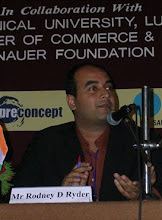
Says Rodney D Ryder, Partner and Head of the Technology Practice at Law Firm Kochhar & Co, which represented the Kolkata-headquartered company, “The domain name is the virtual address of a company, a web mark so to speak. Allowing this domain name registration would be harmful to the ITC/Wills brand as this could also have serious consequences for the company under the Amended Information Technology Act of 2000.” Under the provisions of this act, if a corporate body does not take reasonable security measures to safeguard its data, it could be held liable for any lapse in its data security. The company will be liable to pay compensation up to Rs 5 crore to the parties who has been caused wrongful loss due to deficiency in the security measures adopted by the company.

Registrations under the .in domain have been open since February 2005. Till now, 5 lakh Indian top level domain name extensions have been registered. It is expected in 2 years to cross to 10 lakh registrations. There have been 79 domain name disputes been resolved so far by through The National Internet Exchange of India (NIXI) under the INDRP. Under the Trademarks Act and the Indian Arbitration & Conciliation Act of 1996 cybersquatting disputes are required to be resolved within 45 days up to two months.

Cybersquatting does not only lead to the dilution and/or tarnishment of the brand; if brand owners continue to ignore these sites, such acquiesce could act as a limitation to infringement/cybersquatting actions in the future. Also, this could morph into a phishing or vishing scam or some other dangerous instance of cyber fraud. The domain names should rightfully belong to the brand owner.

In addition, with the enactment of the Information Technology Amendment Act, 2008, the organisation under various provisions has the responsibility to ensure that ‘...reasonable security measures’ are put in place. The organisation could be liable in the event that it ‘acquiesces’ or ‘allows’ its intellectual property or corporate identity to be misused.

Tuesday, March 17, 2009

Cybersquatting up by 8 per cent in 2008: WIPO

Cybersquatting -- holding web domain names hostage for profit -- rose to record levels in 2008, the UN agency for intellectual property rights said.

According to the World Intellectual Property Organisation (WIPO), a record of 2,329 complaints of cybersquatting an 8 per cent increase over 2007 were filed last year, mostly by trademark holders whose names were reserved on the web by other parties.

The increasing number of cases filed with its Arbitration and Mediation Center is occurring at a time when many more domain slots are about to be launched by the Internet Corporation for Assigned Names and Numbers (ICANN), it said adding it expects an in crease in number of such cases.

Friday, July 25, 2008

Author's estate wins battle of Narnia domain name [UK]

A couple who bought a web domain name as a birthday present for their 11-year-old son have lost a battle with the estate of C.S. Lewis to keep it. Richard and Gillian Saville-Smith, from Edinburgh, paid £70 for the name www.narnia.mobi in September 2006 so that their son Comrie, who is a fan of C.S. Lewis, could use it as an e-mail address. The author's estate lodged a complaint with the World Intellectual Property Organisation, which ruled yesterday that the domain name should be transferred.


Companies had a three-month period in 2006 to express interest in .mobi website names before they became more widely available. The couple bought the Narnia name, along with a number of others, including The Queen.mobi and USPresident.mobi, “just for fun”.

Domain name disputes focus partly on whether a “cybersquatter” is using the site for commercial gain and whether trademarks are involved. Mr Saville-Smith claimed yesterday that he had done nothing at all with the site and had not tried to make any money from it.

Monday, July 21, 2008

Cybersquatting: Don’t let your IP slip through the net

Cybersquatting is the practice of registering domain names incorporating trade marks of third party companies and then trying to sell the domain name back (for a handsome profit) to the trade mark proprietor. It's not going away - it's growing and it's a huge problem for trade mark proprietors.

The number of domain name disputes lodged in terms of the Uniform Domain Name Dispute Resolution Procedure (UDRP) that applies to .com, .net and .org domain names increased by 18% in 2007 compared to the number filed in 2006 and by 48% versus the number lodged in 2005.
The increase can be attributed to:
The rise of "pay-per-click" advertising, whereby cybersquatters associate the domain name they have registered with a website containing adverts promoting a variety of competing brands. Every time Internet users access this website and click on one of the adverts, the cybersquatter receives money.
Domain tasting, whereby cybersquatters register a number of domain names and then wait several days before paying for the domain names. They then count the domain names that attract the most Internet users and then pay for only for those. The remaining domain names are then deleted. Problem is, in the period between the cybersquatter registering and paying (or does not pay) for the domain name, it is reflected as being registered.
The use of privacy services by cybersquatters, who are thereby able to register domain names without revealing their identity to the general public. Cybersquatters can thus remain anonymous while trade mark proprietors must go to great lengths to establish the cybersquatter's identity.
There are a number of steps that companies can take to combat cybersquatting, the most important of which is to develop a domain name registration and conflict policy.
Such a policy would clearly identify relevant criteria to determine which domain names should be registered, whose responsibility it is to administer them and in which countries they should be registered.
As a general rule, companies should ensure that companies register their trade marks and trading names in the countries in which they trade, thereby preventing third parties from launching a website to sell competing goods and services under a domain name identical to a company's trade marks and trading names.
Not only should a company continually ensure that its most important trade marks and trading names are registered as domain names, but it should continually monitor what domain names have been registered that incorporate its trade marks and trading names.
In short, companies must monitor the domain name space to check what domain names have been registered that might incorporate their trade marks and domain names.

Aslan et al take on Edinburgh couple for Narnia.mobi [UK]

A major test case on internet names is due to be resolved – with the couple who bought narnia.mobi taking on the company that owns the rights to CS Lewis' world-famous books. CS Lewis (Pte) Ltd contests that Richard and Gillian Saville-Smith are essentially cybersquatting by owning the domain – which they say they bought for their 11-year-old son Comrie.


"We were saving it as a surprise for our little boy's birthday – to coincide with the release of the new Narnia film – so that he could have one of the coolest email addresses in the world!" poet Mrs Saville-Smith told the BBC.


The domain was bought back in 2006, when the new .mobi domains came in and the case is being investigated by the World Intellectual Property Organisation (WIPO). CS Lewis (Pte) Ltd has insisted that Mr and Mrs Saville-Smith have been using the domain in 'bad faith' to make money, a claim which the couple, from Edinburgh, deny.