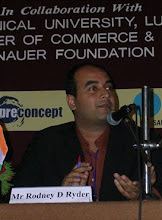
Friday, August 28, 2009
Tata Sons wins case against travel portal
Monday, July 13, 2009
Software Company [Rosetta Stone] Sues Google for Trademark Infringement [United States]
The suit, filed by Gibson, Dunn & Crutcher partner Terence Ross at the U.S. District Court for the Eastern District of Virginia, is just the latest to target Google for its AdWords program, which lets companies buy advertisements that run alongside its search engine results. The ads are triggered by certain keywords, and show up as "sponsored links."
"Google either is misleading or will mislead consumers in innumerable different ways," the complaint states. "Accordingly, it is impossible for Rosetta Stone to cure this problem merely by pursuing remedies against Google's advertisers alone."
"There's not going to be any quick resolution of any of these" suits, he said. "You could get different outcomes from different juries over time."
"As a result of this change in policy, we may be subject to more trademark infringement lawsuits," the company stated. "Adverse results in these lawsuits may result in, or even compel, a change in this practice which could result in a loss of revenue for us, which could harm our business."
This article first appeared on The BLT: The Blog of Legal Times.
Monday, April 06, 2009
Google Must Face Trademark Suit Involving Keyword Ads [2nd Circuit; United States]
The three-judge panel reversed a lower court's dismissal of Rescuecom v. Google, 06-4881, in which computer-repair company Rescuecom had claimed that users could be confused by links to competitors' ads that appear alongside Google search results for the company's trademarked name.
Google had persuaded the lower court to toss the case, arguing that its use of Rescuecom's trademark was internal and not a "use in commerce," which constitutes trademark infringement. The dismissal was hailed as a big victory for Google and other search engines, for which keyword advertising is a lucrative business.
The appeals court ruled Friday that "Google's recommendation and sale of Rescuecom's mark to its advertising customers are not internal uses," sending the case back to the trial court. IP lawyers had been anticipating the decision because of mixed rulings on keyword cases.
In dismissing the case, the lower court had relied on 2nd Circuit precedent in the watershed case of 1-800 Contacts v. WhenU.com., which found that 1-800-Contacts didn't have its trademark infringed by keyword advertising sales. In Friday's ruling, the 2nd Circuit expended considerable effort explaining how the Rescuecom case is different. The 2nd Circuit decision doesn't offer that many answers about the legality of keyword advertising. Rescuecom and others will still have to prove their trademarks were infringed in the end.
Thursday, March 19, 2009
ITC evicts squatter from Indian Domain Name
Says Rodney D Ryder, Partner and Head of the Technology Practice at Law Firm Kochhar & Co, which represented the Kolkata-headquartered company, “The domain name is the virtual address of a company, a web mark so to speak. Allowing this domain name registration would be harmful to the ITC/Wills brand as this could also have serious consequences for the company under the Amended Information Technology Act of 2000.” Under the provisions of this act, if a corporate body does not take reasonable security measures to safeguard its data, it could be held liable for any lapse in its data security. The company will be liable to pay compensation up to Rs 5 crore to the parties who has been caused wrongful loss due to deficiency in the security measures adopted by the company.
Registrations under the .in domain have been open since February 2005. Till now, 5 lakh Indian top level domain name extensions have been registered. It is expected in 2 years to cross to 10 lakh registrations. There have been 79 domain name disputes been resolved so far by through The National Internet Exchange of India (NIXI) under the INDRP. Under the Trademarks Act and the Indian Arbitration & Conciliation Act of 1996 cybersquatting disputes are required to be resolved within 45 days up to two months.
Cybersquatting does not only lead to the dilution and/or tarnishment of the brand; if brand owners continue to ignore these sites, such acquiesce could act as a limitation to infringement/cybersquatting actions in the future. Also, this could morph into a phishing or vishing scam or some other dangerous instance of cyber fraud. The domain names should rightfully belong to the brand owner.
In addition, with the enactment of the Information Technology Amendment Act, 2008, the organisation under various provisions has the responsibility to ensure that ‘...reasonable security measures’ are put in place. The organisation could be liable in the event that it ‘acquiesces’ or ‘allows’ its intellectual property or corporate identity to be misused.
Tuesday, March 17, 2009
Cybersquatting up by 8 per cent in 2008: WIPO
According to the World Intellectual Property Organisation (WIPO), a record of 2,329 complaints of cybersquatting an 8 per cent increase over 2007 were filed last year, mostly by trademark holders whose names were reserved on the web by other parties.
The increasing number of cases filed with its Arbitration and Mediation Center is occurring at a time when many more domain slots are about to be launched by the Internet Corporation for Assigned Names and Numbers (ICANN), it said adding it expects an in crease in number of such cases.
Global trademark activities grew 5.3% in 2008 [International]
Sunday, March 08, 2009
Trademark fee cut in the United Kingdom: Could price wars loom? [United Kingdom]
A price war looked set to break out on Monday over trademark fees, as the UK’s Intellectual Property Office proposes its first cuts in charges for more than a decade. The move comes just days after European Union countries agreed to let the European trademark office – formally known as the Office of Harmonisation for the Internal Market – cut its fees by 40 per cent.
The cuts by the IPO are expected in particular to benefit small and medium-sized companies that often find the costs of protecting their intellectual property onerous. The IPO will unveil on Monday proposals to reduce its fees for trademark applications made electronically by 15 per cent, and offer additional price reductions for companies that want to oppose applications.
It will also give companies more ability to pay only part of the application fee up-front, meaning that less money should lost when applications are abandoned. The proposed reductions will be subject to consultation before coming into force in October.
The Alicante-based OHIM issues the “community trademark”, an intellectual property right that applies across the 27-country EU bloc, while the IPO – like other national offices in Europe – administers lower-cost trademarks that give domestic protection only. Some EU countries were concerned that the OHIM’s move, which was prompted by unexpected popularity of the community trademark and subsequent financial surpluses at the office, might undercut business at their national offices. The UK move comes after a decline in domestic applications for patent and trademark applications, which fell 12 per cent last year.
Tuesday, January 13, 2009
Thanjavur Dolls acquire GI Status [India]
Monday, September 08, 2008
Mattel blocks 'Scrabulous' in India [Intellectual Property]
The networking site, Facebook, has restricted the popular “add-on” application, ‘Scrabulous’ to most users. Mattel Inc. owns Scrabble rights outside Canada and the United States of America and had approached the Indian courts in February 2008, seeking an order for taking down Scrabulous from Facebook and other servers.
The brothers, Rajat and Jayant Agarwalla, and their web-design and technology company, R J Software, were previously served a lawsuit by game-making giant Hasbro Inc., owner of Scrabble rights in Canada and the U.S. , at a New York federal court for violating its copyright and trademarks. Hasbro also sent a notice demanding that Facebook remove the application from the site. “Facebook took the unfortunate decision to restrict most users from accessing Scrabulous on August 22, in response to a ‘take down notice’ from Mattel on August 14,” said Mr. Jayant.
Mr. Jayant said, “The High Court had reserved judgement in this matter after hearing both parties. It surprises us that Mattel chose to direct Facebook to take down Scrabulous without waiting for the High Court’s decision.” He also sounded disappointed with Facebook as he said, “It is even more astonishing that Facebook, which claims to be fair and neutral party, took the step even though they were fully aware of the circumstances under which the Mattel letter was sent.”
“We now await the decision of the High Court and shall accordingly decide our future course of action regarding Scrabulous,” Mr. Jayant asserted.
Friday, July 25, 2008
Author's estate wins battle of Narnia domain name [UK]
A couple who bought a web domain name as a birthday present for their 11-year-old son have lost a battle with the estate of C.S. Lewis to keep it. Richard and Gillian Saville-Smith, from Edinburgh, paid £70 for the name www.narnia.mobi in September 2006 so that their son Comrie, who is a fan of C.S. Lewis, could use it as an e-mail address. The author's estate lodged a complaint with the World Intellectual Property Organisation, which ruled yesterday that the domain name should be transferred.
Companies had a three-month period in 2006 to express interest in .mobi website names before they became more widely available. The couple bought the Narnia name, along with a number of others, including The Queen.mobi and USPresident.mobi, “just for fun”.
Domain name disputes focus partly on whether a “cybersquatter” is using the site for commercial gain and whether trademarks are involved. Mr Saville-Smith claimed yesterday that he had done nothing at all with the site and had not tried to make any money from it.
Monday, July 21, 2008
Internet domains to open up, prepare for .whatever [International]
"Dot-com," the ubiquitous term that has come to serve as a description for all things Internet-related, could be in the sunset of its heyday following a key decision on domain names.
The Internet Corporation for Assigned Names and Numbers, or Icann -- the body that regulates the Internet, voted unanimously on Thursday to ease up restrictions on domain names such as .com or .net.
The decision, made on the final day of week-long meetings in Paris, could trigger a frenzy of bidding as companies rush to claim domains like .investment or .travel. In fact almost anything could become a web address under the new rules -- from personal names to trademarked brands for major corporations. Be prepared for .news, .startrekfans and .somethinginappropriate.
Bidding wars for domain names are expected to reach well in the six-figures. "You can pretty much guarantee, unfortunately, (that) the most sought after one will probably be .sex," Bryan Glick of Computing Magazine said. Although, that could mean pornographic sites would move to their own neighbourhood on the web, making it more difficult to unintentionally stumble onto naughty sites. Individuals could get domains named after themselves so long as they could prove they have a business plan and "technical capacity" according to the plans for the system.
However, companies with intellectual property linked to a specific name will have first dibs on their own domain, like .ctv, for example. The new rules would mark a historic change from the current system where only .com, .net, .edu or .org are permitted, in addition to country domains like .ca or .au.
The new system could be in place as early as next year, but many details have to be worked out first.
Tuesday, June 03, 2008
E-filing in India, a long way to go [IP in India]
The government’s ambitious project to encourage electronic filing of patent and trademark applications has received an embarrassingly poor response in its first year. Of the 35,000 patent applications filed last year, only 410 (1.17%) were filed online. Worse, only 0.24% or 242 of the one lakh trademark applications during 2007-08 were filed online.
The facility for filing of patent and trademark applications from anywhere in the world at any time through the Internet, was launched in July 2007 to help the Indian Patent and Trade Mark Offices function as paperless offices. Government officials termed the poor show as “teething troubles” and blamed it on ignorance and reluctance on the part of Companies and individuals to use the new system.
To correct the situation, the government had asked patent officers and the National Informatics Centre (NIC) to provide training to patent attorneys, through a programme conducted in the four metros. Consequently, in the two months of the current financial year, online applications for patents and trademarks have improved marginally. Online applications constituted 4.9% of the 6,000 patent applications filed so far in this financial year while it also constituted 1.34% of the 20,000 trademark applications.
Currently, there are only about a dozen countries that have e-filing facilities, with India recently becoming a member of this elite group which consists of countries like USA , Japan , South Korea, China and the European Patent Office. With patent applications from China outstripping those from India by leaps and bounds, the Centre has launched a national awareness, sensitisation and consultancy programme by roping in universities, laboratories, state level chambers of commerce and industry, patent attorneys and the scientific community.
The proactive campaign which involves an outlay of Rs 20 crore, would establish a correlation between intellectual property, innovation, productivity and competitiveness. The objective of the programme was to take the intellectual property regime to the bottom of the industrial pyramid and invigorate the proprietary rights culture in the country. An effective online filing system can prove to be the lynchpin for this strategy’s success.
The benefits of e-filing of patent and trademark applications include getting an application number immediately, on-line verification assuring error-free filing and obtaining the filing date, a speedy registration process, being able to save the date locally in the applicant’s personal computer, printing the completed application data and recalling the contact details for subsequent applications. This would have meant savings on paper, valuable time and money.
Payments can be made through the Payment Gateway of authorised bankers, which would save time and money and also put an end to the hassles involved in visiting and filing the applications in the offices. NIC has developed modules for e-filing and on-line processing with State Bank of India providing the payment gateway.
But patent lawyers said though the e-filing system is a major improvement over the previous one, it also hasits own limitations.
Incidentally, the government is working towards sending more officials to be trained by the World Intellectual Property Organisation, UNIDO, as well as Japanese and US patent offices. Several vacant posts of patent examinees also need to be filled up.
To enhance the prestige of the Indian Patent Office (IPO) and to attract work from abroad, the government is also in the process of transforming IPO into an International Search Authority and an International Preliminary Examining Authority under the Patent Cooperation Treaty. Currently, there are only 12 such authorities.
Besides, India would soon join the Madrid Protocol on Trade Marks. Madrid Protocol is a simple and cost-effective system for registration of International Trademarks. India’s membership of the Madrid Protocol will aid Indian Companies in registering their trademarks in other member countries of the Protocol through a single application.
Thursday, May 29, 2008
Will 'Peter the Scot' harm Indian Geographical Indications? [India]
A ruling by the Supreme Court on Tuesday ended the almost two-decades-long challenge by an association of Scotch whisky makers to Khoday India Ltd’s right to have a non-Scotch whisky brand called Peter Scot because of the similarity between the words “Scot” and “Scotch”.
But the ruling could result in global retaliation and affect Indian products such as basmati rice and Assam tea, say analysts. That’s because the Supreme Court ruled in favour of Khoday despite the geographical indication (GI) status enjoyed by Scotch. Unlike a trademark—a unique and distinctive sign to identify a product or service—a GI is a sign used on goods that have a specific place of origin and possess qualities or reputation that are due to that origin.
In many cases, a GI is merely the name of the place where the goods originate. “Champagne” and “Tuscany” are some examples of GIs. Indian examples include “Assam tea”, “Darjeeling tea” and “Kanchipuram silk saree”. Basmati rice is also a GI.
In this case, Khoday, which began producing Peter Scot 40 years ago, registered the trademark in 1974. Twelve years later, the Scotch Whisky Association or SWA, a group of manufacturers and exporters of Scotch whisky, raised an objection before the registrar of trademarks, arguing that the word “Scot” was deceptively similar to “Scotch” and would mislead the consumers into believing that the product was of Scottish origin. The registrar ruled in SWA’s favour.
Khoday appealed to the Madras high court which too ruled against it. The high court order delivered in October was challenged by Khoday in the Supreme Court.
A two-judge bench on Tuesday allowed the appeal and validated the use of the trademark “Peter Scot”.
The judgement swung in favour of Khoday on two points. The first was the delay of 12 years on part of SWA in filing an objection.
The second was that consumers of Scotch whisky in India are discerning enough to distinguish between Scotch whisky and whisky made in India.
Referring to precedents from countries such as Australia and the US, the judges said the legal test applied to check deception of consumers by the high court were incorrect.
The judgement states: “However, tests laid down in Australia and United States in respect of self-same goods are noticed herein before are somewhat different. But then we are concerned with the class of buyer who is supposed to know the value of money, the quality and content of scotch whisky. They are supposed to be aware of the difference of the process of manufacture, the place of manufacture and their origin.”
The apex court’s judgement, interestingly, overturns numerous verdicts of high courts in the country that granted SWA relief by passing restraining orders against liquor manufacturers in India for using words such as “Scot”, “Highland” and “Chief”, words that SWA contended were associated with Scotch whisky brewed in Scotland.
Monday, May 26, 2008
Settle Toshiba vs Tosiba fast: Supreme Court asks Delhi High Court [India]
The Supreme Court has asked the Delhi HC to expeditiously decide the trademark dispute between the Japanese company Toshiba and an Indian company which uses the trademark Tosiba for its electrical goods.
The largest manufacturer of heavy electrical items of Japan claims that such a use infringes on its trademark Toshiba. Justice SB Sinha and Justice LS Panta said: “We would, however, request the Delhi High Court to consider the desirability of disposing of the suit filed by the appellant (Kabushiki Kaisha Toshiba) against the respondent (Tosiba Appliances Co) as expeditiously as possible”. It in its notice, the company had said: “The trademark Toshiba is such a well-known trademark in India and abroad that its use or the use of a phonetic equivalent mark in respect of electronic and electrical goods would cause immense confusion and deception amongst the purchasing public and the trade. Our clients were surprised when they recently learnt of the adoption and use of the mark Tosiba both as your trademark and an essential feature of your trading style in respect of a range of electrical goods including electric irons. The adoption of the mark Tosiba is clearly mala fide and amounts to infringement of our clients’ various registered trade marks.”
Starbucks registers trademark in several Indian languages [India]
Scalded by trademark infringement from names including Starstruck, global coffee giant Starbucks Corp. is taking no chances.
The Seattle, US-based company has trademarked the “Starbucks” brand in at least 10 Indian languages, including Tamil, Telugu, Punjabi, Bangla, Gujarati and even Urdu—almost as diverse as the states it eventually set up shop in.
It’s still unclear when Starbucks will enter India after the international coffee chain withdrew its application from the Foreign Investment Promotion Board, which approves investments into the country from abroad, in November because government officials raised objections to the majority foreign holding structure of the proposed venture. In India, overseas brands can’t hold more than 51% of any single-brand outlet. Starbucks’ overseas holding was adding up to more than that.
Stung by the objections, Starbucks decided to put on hold its India plans. With the ranks of middle-class Indian swelling, drinking coffee in outlets similar to Starbucks is becoming fashionable in India’s cities and big towns. The country already has several indigenous brands such as Barista and Cafe Coffee Day, and international ones such as Costa Coffee. But with coffee drinking turning into a fad, even those who have had little to do with coffee chains have stepped in. India’s first and most celebratedproducer of herbal beauty potions and creams, Shahnaz Husain, has registered Startstruck as a trademark, brewing up a bit of storm. Starbucks is locked in a legal battle over the similar sounding name.
Starbucks is also challenging another case in India’s Controller General of Patents, Designs and Trade Marks for a deceptively similar name. The American chain is now in 13,000 locations worldwide and if the company has its way, it will be in 27,000 more locations, including some in India.
Friday, May 23, 2008
Trademark Battle: Biyani v. Ambani [India]
India’s big guns are having a bazaar battle.
Kishore Biyani, one of the biggest names in domestic retail, has locked horns with one of India’s richest men, Anil Ambani, over a small name with big stakes: Big Bazar.
Reliance Anil Dhirubhai Ambani Group has filed to register Reliance Big Bazar with India’s trademark authority. The application says it claims “no right” to “exclusive use of word ‘Big Bazar’”, which means the company will only use the name as Reliance Big Bazar, according to the document filed.
Meanwhile, Biyani’s flagship hypermarkets are called Big Bazaar, with a double “a”, spelling it the way Oxford English Dictionary spells the word to define a market.
Still, Biyani says he considers the younger Ambani’s move as an attempt to misappropriate a brand he has nurtured for years into one of India’s best known retail names.
There are 89 Big Bazaars in India and the format is the highest revenue and profit generating unit for the Future Group that Biyani founded. Biyani has plans to hive off Big Bazaar and may eventually take it public after doubling the number of stores by March 2009.
“They are using a name which was created by us,” says Biyani, managing director of Pantaloon Retail. Therefore, “we are opposing” it.
The Anil Ambani-led wing of the former Reliance group, on the other hand, uses ‘Big’ as the moniker for its entertainment and media channels ranging from Big FM, India’s largest radio network, to Big Video, Big Music, Big Flicks under Reliance Big Entertainment Pvt Ltd.
Big Bazar is “one of the many names under consideration by Reliance Big Entertainment for aggregated retailing of our entertainment products and services under one umbrella brand” says a spokesperson for Reliance.
Reliance Adag applied in November 2006 for trademark registration of the name under two separate categories of trademark registration: class 28 that covers trademark in games and playthings, gymnastics and sporting articles and class 35 that deals in advertising, business management, business administration and office functions.
The registrations, carried under the company’s unit Anil Dhirubhai Ambani Ventures Pvt. Ltd, was made public by the country’s controller general of patents, designs and trademark in November, allowing for any opposition to file their objections.
Companies opposing trademark applications are supposed to mark their objections in three to four months’ time from the date it was madepublic.
“We have filed oppositions for both (the cases),” Biyani said.
Local and foreign retailers from McDonald’s Corp. to Wal-Mart Stores Inc. have been involved in alleged trademarks infringement cases in India as local individualsand firms have trademarked names such as 7 Eleven and Burger King.
However, it is unusual for two Indian corporate giants to get into a fight over such major brand name.
Monday, April 14, 2008
SC reserves verdict in Dabur trademark case [India]
The Supreme Court on Friday reserved its judgement on a petition filed by Dabur India, which sought to restrain Andhra Pradesh-based K R Industries from violating the intellectual property rights on Dabur Dant Manjan (tooth powder).
A bench headed by Justice S B Sinha reserved the verdict on Dabur's plea against a Delhi High Court order that partly dismissed its petition on alleged IPR infringement by K R Industries. Dabur had moved the High Court in 2002 alleging that K R Industries was infringing its copyright by copying similar colour combination, layout and features as that of Dabur Dant Manjan. The division bench of the High Court had directed Dabur not to combine two different causes of action infringement of copyright and selling goods in similar packaging. The High Court observed that it did not have the territorial jurisdiction to decide on the issue and asked Dabur to file a fresh petition in a competent court.
According to Dabur, it had asked K R Industries to stop manufacturing and marketing its product in a similar packaging and colour combination as that of Dabur Dant Manjan. K R Industries had denied the allegations and filed an application saying that the Delhi High Court did not have the jurisdiction to entertain the Dabur's petition.
Thursday, April 03, 2008
WIPO Member States Adopt 2008/09 Program and Budget
The proposed level of expenditure for the 2008/09 biennium is 626.3 million Swiss Francs (SFr). The full proposed program and budget for the 2008/09 biennium is available at http://www.wipo.int/edocs/mdocs/govbody/en/a_44/a_44_2.pdf. The program and budget 2008/09 was adopted with no prejudice to any adjustments that may be required during the biennium.
The Chairman of the General Assembly, Ambassador Martin I. Uhomoibhi, who is also the Permanent Representative of Nigeria to the United Nations in Geneva, said the agreement is the result “of active consultations and negotiations aimed at resolving all pending issues” since the last WIPO Assemblies session in September-October 2007. Ambassador Uhomoibhi said “The outcome achieved was the collective agreement that this Extraordinary Session be convoked principally to adopt the budget. The fact that we are meeting here today, 31 March 2008, is a result of the agreement reached during these negotiations.” Ambassador Uhomoibhi said this session of the General Assembly will go down in history as one of the briefest, characterized by candor and clarity of all concerned. “I am personally touched by this cooperative spirit,” he added.
The agreement included a decision to reduce the international filing fee under the PCT by 5% (this means that the international filing fee will fall from 1,400 SFr to 1,330 SFr) and to increase the reduction from 75% to 90% for countries whose per capita national income is below US$3,000, as well as to Antigua and Barbuda, Bahrain, Barbados, Libyan Arab Jamahiriya, Oman, Seychelles, Singapore, Trinidad and Tobago and the United Arab Emirates. This fee reduction will be effective from 1 July 2008.
Speaking after the meeting, the Director General of WIPO, Dr. Kamil Idris, welcomed today’s decision on the program and budget for the 2008/09 biennium. He said “The adoption of the budget today is a sign of goodwill by all member states…It reflects mutual understanding that the Organization should move on.”
Tuesday, April 01, 2008
ITC, Punchgini and Bukhara: ITC prevails as Second Circuit Court applies Unfair Competition [United States]
The Second Circuit refused to acknowledge trademark infringement because the plaintiff had abandoned the use of the trademark in the US, though they continued to operate in India.
The New York Court of Appeals later concluded that New York law "recognizes common law unfair competition claims, but not the ‘famous’ or ‘well-known’ marks doctrine."
Unfair Competition law prohibits use of another’s trademark or indication which is identical or similar to other persons goods that are widely recognized among users and thereby causing one's goods or business to be confounded with another person's business. Accordingly, “when a business, through reknown in New York, possesses goodwill constituting property or commercial advantage in this state, that goodwill is protected from misappropriation under New York unfair competition law. This is so whether the business is domestic or foreign.” Further, it was stated that the consumers of services provided by the defendants “must primarily associate the mark with the foreign plaintiff.” The court refused to exhaustively state the factors to determine this, stating that they would “vary with the facts of each case”. However, there has to be “evidence that the defendant intentionally associated its goods with those of the foreign plaintiff in the minds of the public, such as public statements or advertising stating or implying a connection with the foreign plaintiff; direct evidence, such as consumer surveys, indicating that consumers of defendant's goods or services believe them to be associated with the plaintiff; and evidence of actual overlap between customers of the New York defendant and the foreign plaintiff.”
The case is foundational in that it represents a paradigm shift in protection of foreign trademarks in the US. They now qualify for protection even though they may not be registered in the US, the underlying principle being that commercial unfairness should be restrained whenever there is misappropriation, for the benefit of the person who holds a legitimate property right.
Monday, March 31, 2008
Indian Government to launch Rs. 300 Crore awareness programme on Intellectual Property [India]
The Indian government plans to revamp the existing intellectual property implementation mechanism to address concerns of international players in the pharma, and food and information technology industries.
The Department of Industrial Policy and Promotion (DIPP), the nodal department that handles intellectual property rights (IPR) related matters under the commerce ministry, is launching an ambitious Rs 300-crore project to sensitise all stakeholders, including law enforcement agencies, scientists, companies, ministries and the general public on IPR issues.
The department also plans to set up a state-of-the-art trademark registry office in Ahmedabad and enhance infrastructure capacities of the existing trademark office in New Delhi.
It is also planning to set up a National Institute for Intellectual Property Management at Nagpur. These steps come soon after the patent office modernisation programme that cost Rs 149 crore.
The project is in response to demands that India raises the level of intellectual property protection available in the country to multinational players.
On March 13, DIPP organised a meeting of all concerned ministries and departments that handle IP to facilitate better coordination and understanding on IP issues for improved compliance.
According to sources, DIPP wanted an update on all current and emerging issues in IP from ministries like education, health, information and broadcasting, chemicals and petrochemicals and agriculture.
Among the current issues that were discussed by these ministries were optical disc legislation (an initiative by the Ministry of Information and Broadcasting), copyright on internet (a matter pending with the department of higher education) and the protection of traditional knowledge.
Even though DIPP does not consider the issue of secrecy of clinical trial data as an IP problem, “data protection” was also discussed in the meeting.
“Data protection issues were discussed in the meeting as it is often linked to IP. A high-level committee headed by former chemical secretary had looked into the matter and gave its recommendations for data protection clauses in pharmaceutical and agrochemicals. We have been discussing these issues to facilitate exchange of views,” sources said.
The issue of “data protection” has been a matter of serious concern for multinational pharmaceutical companies for a long time.